
Pressure Gauge and Thermowell RFQ Checklist
A practical RFQ checklist for pressure gauges, thermowells, diaphragm seals, siphons, needle valves, adapters, documentation, and approved alternates.
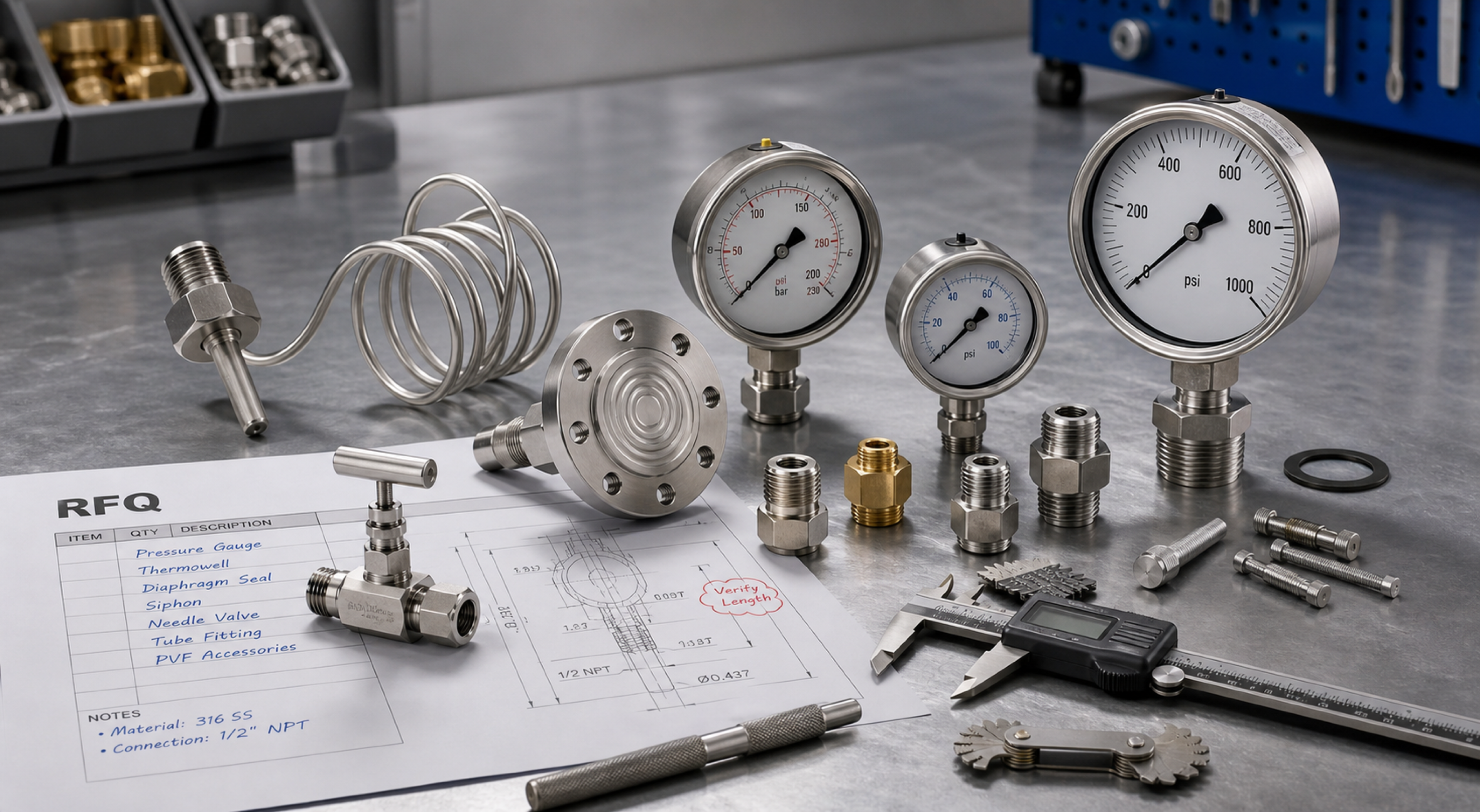
Pressure gauges and thermowells are often treated as small instrumentation line items, but the wrong range, connection, material, seal, or accessory can delay a skid build, pump repair, boiler room job, test stand, or maintenance outage. A request that says only "0 to 100 psi gauge" can miss dial size, accuracy, wetted material, thread form, fill, mounting, process temperature, pulsation, isolation, and documentation.
This checklist is built for maintenance buyers, PVF manufacturers, instrumentation teams, industrial job shops, and purchasing groups that need cleaner RFQs for pressure gauges, compound gauges, thermowells, diaphragm seals, siphons, snubbers, needle valves, gauge cocks, adapters, gaskets, fasteners, and related MRO supplies. It focuses on the fields Westgate needs to quote practical, domestic, documented, and approval-ready options without turning a simple gauge request into a rework loop.
Start with the measurement point and equipment tag
Source gauges and thermowells against the equipment they protect, not as loose catalog parts. Include the pump, compressor, boiler, heat exchanger, hydraulic unit, test stand, skid, tank, steam line, air header, or process line where the item will be installed. Equipment context helps determine whether the quote needs a utility gauge, a liquid-filled gauge, a high-temperature accessory package, a diaphragm seal, or a documented customer-approved replacement.
Tag numbers, photos, prior purchase orders, and marked drawings are useful even when the old part number is incomplete. They help Westgate connect the gauge or thermowell to surrounding PVF, fasteners, gaskets, electrical items, tube fittings, sealant, labels, and tools that may belong on the same RFQ.
Control pressure range, scale, and accuracy
List the pressure range exactly, including vacuum or compound ranges when needed. A gauge for 0 to 100 psi, 0 to 160 psi, 30 inches vacuum to 100 psi, 0 to 600 psi, or 0 to 1,000 psi is not interchangeable just because the connection size matches. If the gauge needs psi, bar, kPa, dual scale, color bands, maximum pointer, or calibration data, put that in the first request.
Accuracy and readability should match the job. Include dial size, accuracy class or tolerance, normal operating pressure, pressure spikes, vibration, pulsation, and whether the gauge is used for process indication, maintenance troubleshooting, hydrostatic testing, customer equipment, or quality records. That context helps separate inexpensive utility gauges from test gauges, filled gauges, or calibration-supported options.
Name connection, mounting, and installed orientation
The RFQ should state process connection size, thread type, lower mount, back mount, panel mount, flange mount, stem length, insertion length, and any clearance limits around the installed point. Do not assume every plant or imported machine uses the same NPT connection. BSP, metric, sanitary, flanged, socket weld, and customer-specific adapters can change the quote.
For replacement work, photos with a ruler help confirm dial diameter, case style, wrench flats, connection location, thermowell shank length, lagging extension, bore, thread engagement, and handle clearance around nearby valves or pipe supports. A stocked gauge can be correct electrically and mechanically but still fail if the operator cannot read it or the connection points the dial into the equipment frame.
Match wetted materials to media and temperature
Material choices should follow the service. Include media, temperature range, pressure range, corrosion exposure, outdoor weather, washdown, steam, condensate, water, compressed air, hydraulic oil, fuel, chemicals, wastewater, or sanitary requirements when relevant. Brass internals, stainless wetted parts, Monel, Hastelloy, PTFE-lined seals, elastomer seals, and specialty fills are different sourcing decisions.
Thermowells need their own material and dimensional controls. State stem style, process connection, instrument connection, insertion length, shank diameter, bore, tip style, lagging extension, wake frequency requirements if applicable, and whether the thermowell is threaded, flanged, socket weld, weld-in, or sanitary. If engineering owns thermowell approval, make that approval path visible on the RFQ.
Quote protection accessories as part of the assembly
Many gauge failures come from missing accessories rather than the gauge itself. Name whether the assembly needs a siphon, snubber, pulsation dampener, needle valve, gauge cock, isolation valve, block-and-bleed valve, diaphragm seal, capillary, cooling tower, overpressure protector, adapter, union, pipe nipple, gasket, fasteners, sealant, or mounting bracket.
Accessory choices should match the installation environment. Steam service may need a siphon and isolation valve. Vibration may push the quote toward a filled gauge or remote mount. Corrosive or viscous media may require a diaphragm seal. High pulsation may require a snubber. Clear accessory notes let Westgate quote the working package instead of a gauge that still needs field fixes.
Separate exact replacements from approved alternates
Instrumentation alternates should be controlled carefully. A manufacturer alternate with the same range, accuracy, wetted material, connection, case style, fill, and documentation is different from a changed material, changed range, changed dial size, or added seal package. Ask Westgate to quote exact-match, domestic, documented, and fastest-available options as separate lines when both speed and approval matter.
Put paperwork requirements in the first request: COC, country of origin, calibration certificate, data sheet, material certificate, pressure rating, temperature rating, hazardous area or sanitary documentation, customer approval notes, and line-item exceptions. That keeps receiving, quality, engineering, and maintenance from finding the documentation gap after the order is already late.
RFQ checklist
- Equipment tag, service, installation point, replacement or new-build context, and failure mode
- Gauge type such as pressure, vacuum, compound, differential, test, liquid-filled, or utility gauge
- Pressure range, units, dual scale, dial size, accuracy, normal operating pressure, and spike exposure
- Process connection size, thread form, lower mount, back mount, panel mount, flange mount, or adapter need
- Thermowell material, process connection, instrument connection, insertion length, shank, bore, and tip style
- Media, temperature range, corrosion, vibration, pulsation, outdoor exposure, steam, air, water, oil, or chemicals
- Wetted materials, case material, fill fluid, diaphragm seal material, elastomers, and sanitary or hazardous requirements
- Siphons, snubbers, needle valves, gauge cocks, isolation valves, adapters, pipe nipples, gaskets, and brackets
- Domestic sourcing, country of origin, approved manufacturer, no-substitution rule, or alternate approval process
- COC, calibration certificate, data sheet, material certificate, pressure rating, temperature rating, or exception notes
- Needed delivery date, ship-to ZIP code, outage priority, partial shipment rules, and approval contact
Related Westgate resources
Send the gauge package before the instrument point becomes a delay
Westgate can quote pressure gauges, thermowells, diaphragm seals, siphons, snubbers, needle valves, PVF parts, domestic fasteners, gaskets, electrical supplies, tools, and related MRO items from one mixed RFQ. Send photos, tags, drawings, prior POs, calibration requirements, or a spreadsheet and we will flag missing range, connection, material, accessory, origin, and documentation fields before sourcing begins.
Request a Quote